

The Theoretical Model Underlying the Survey
Description of the Survey
Conducting the Survey
The Survey Report
Project Fee
The Theoretical Model Underlying the Survey
See exact items of the Quality-of-Community-Healthcare measure and other model constructs shown in the figure in the actual online survey questionnaire in the survey.

Community healthcare satisfaction refers to an overall satisfaction a person may feel toward the general healthcare environment in their community. This overall assessment can be assumed to be a function of the person’s perception of a variety of general healthcare programs and services in the community. These programs or services may include: alcohol and drug abuse programs, inpatient hospital care, outpatient hospital care, and elderly health services, among others.
References
Sirgy, M. J., Hansen, D. E., & Littlefield, J. E. (1994). Does hospital satisfaction affect life satisfaction?. Journal of Macromarketing, 14(2), 36-46.
Sirgy, M. J., Mentzer, J. T., Rahtz, D. R., & Meadow, H. L. (1991). Satisfaction with health care services consumption and life satisfaction among the elderly. Journal of Macromarketing, 11(1), 24-39.
Sirgy, M. J., Rahtz, D. R., Meadow, H. L., & Littlefield, J. E. (1995). Satisfaction with healthcare services and life satisfaction among elderly and non-elderly consumers. Developments in Quality-of-Life Studies in Marketing, 5, 87-91.
Bibliography
Abelson, R. (2002). Patients surge and hospitals hunt for beds. New York Times, March 28.
Aiello, A., Rosenberg, L. J., & Czepiel, J. A. (1977). Scaling the heights of consumer satisfaction: An evaluation of alternative measures. New York University, Graduate School of Business Administration.
Andrews, F. M., & Withey, S. B. (2012). Social indicators of well-being: Americans’ perceptions of life quality. Springer Science & Business Media.
Campbell, A., Converse, P. E., & Rodgers, W. L. (1976). The quality of American life: Perceptions, evaluations, and satisfactions. Russell Sage Foundation.
Chambers, L. W., Ounpuu, S., Krueger, P., & Vermeulen, M. (1997). Quality of life and planning for health boards. Developments in Quality-of-Life Studies (International Society for Quality-of-Life Studies, Blacksburg, Virginia), 11.
Davies, A. R., & Ware Jr, J. E. (1988). Involving consumers in quality of care assessment. Health Affairs, 7(1), 33-48.
Diener, E. (1984). Subjective well-being. Psychological Bulletin, 95(3), 542.
Diener, E., & Fujita, F. (1995). Methodological pitfalls and solutions in satisfaction research. New Dimensions in Marketing/Quality-of-Life Research, 27-46.
Evan, W. M., & Freeman, R. E. (1988). A stakeholder theory of the modern corporation: Kantian capitalism.
Fishbein, M., & Ajzen, I. (1977). Belief, attitude, intention, and behavior: An introduction to theory and research.
Jeffres, L. W., & Dobos, J. (1992). Communication and public perceptions of the quality of life: Testing the model. Developments in Quality-of-Life Studies in Marketing, 4, 43-49.
Maronic, T. J., & Miller, A. R. (1992). Satisfaction and other issues in hearing aid purchases by elderly consumers: a quality-of-life issue. Developments in Quality-of-Life Studies in Marketing, 4, 29-34.
Meadow, H. L. (1983). The relationship between consumer satisfaction and life satisfaction for the elderly.
Meadow, H. L. (1988). The satisfaction attitude hierarchy: does marketing contribute. In Proceedings of the 1988 American Marketing Association Winter Educators’ Conference. American Marketing Association, Chicago, IL (pp. 482-483).
Merkle, J. F. (2002). Computer simulation: A methodology to improve the efficiency in the Brooke Army Medical Center Family Care Clinic. Journal of Healthcare Management, 47(1).
Michalos, A. C. (1996). Migration and the quality of life: A review essay. Social Indicators Research, 39, 121-166.
Moriarty, D. (1997). Tracking population health status and health-related quality of life in the United States. Development in Quality-of-Life Studies, 1, 59.
Norman, W. C., Harwell, R., & Allen, L. R. (1997). The role of recreation on the quality of life of residents in rural communities in South Carolina. Developments in Quality-of-Life Studies, 1, 65.
Oishi, S., Diener, E., Suh, E., & Lucas, R. (1997). Values and sources of subjective well being. Development in Quality-of-Life Studies, 1, 66.
Oishi, S., Diener, E., Suh, E., & Lucas, R. E. (1999). Value as a moderator in subjective well‐being. Journal of Personality, 67(1), 157-184.
Rahtz, D. R., & Sirgy, M. J. (1994). Corporate strategy and quality of life: a strategic planning philosophy and model for a changing health care environment. Advances in Health Care Research (American Association for Advances in Health Care Research, Madison WI), 125-132.
Rahtz, D. R., Sirgy, M. J., & Meadow, H. L. (1989). Exploring the relationship between health care system satisfaction and life satisfaction among the elderly. Developments in Marketing Science, 12, 531-536.
Rahtz, D. R., & Sirgy, M. J. (2000). Marketing of Health Care Within a Community: A Quality-of-Life/Needs Assessment Model and Method. Journal of Business Research, 48(3), 165-176.
Serota, S. P. (2002). The path to affordability. Modern Healthcare, 32(6), 25-25.
Sirgy, M. J. (2001). Handbook of quality-of-life research: An ethical marketing perspective (Vol. 8). Springer Science & Business Media.
Sirgy, M. J. (2002). The psychology of quality of life (Vol. 12). Dordrecht: Kluwer Academic Publishers.
Steenkamp, J. B. E., & Van Trijp, H. C. (1991). The use of LISREL in validating marketing constructs. International Journal of Research in Marketing, 8(4), 283-299.
Wechsler, J. (2002). Healthcare costs to rule policy agenda in 2002: pressure to curb healthcare spending will shape debate on benefits, payments in Washington and across the country.(Politics & Policy). Managed Healthcare Executive, 12(1), 12-14.
Widgery, R. N. (1992). Neighborhood quality of life: A subjective matter. Developments in Quality-of-Life Studies in Marketing, 4, 112-14.
Widgery, R., & Angur, M. G. (1997). Race relations, neighborhood integration, and quality-of-city life. Developments in Quality-of-Life Studies, 1, 101.
Wilkie, W. L., & Pessemier, E. A. (1973). Issues in marketing’s use of multi-attribute attitude models. Journal of Marketing Research, 10(4), 428-441.
Description of the Survey
 |
I. QUALITY OF COMMUNITY HEALTHCARE general healthcare questions |
II. HEALTHCARE SERVICES IN THE COMMUNITY women’s health services, children’s health services, elderly health services, physical fitness programs and facilities, out-patient services, cancer services, alcohol and drug rehabilitation services, etc. |
| III. HEALTHCARE INFORMATION SOURCES television, radio, newspaper, magazine, friends, family, doctor, etc. |
IV. GENERAL HEALTHCARE ISSUES clarity of healthcare information, pricing, control over needs, quality-of care, etc. |
|
| V. PERSONAL HEALTH diet, exercise, health risks |
VI. LIFE SATISFACTION life in general |
|
| VII. DEMOGRAPHICS age, gender, marital status, full-time vs. part-time employment, etc. |
The questionnaire consists of three major sections. The first section (“Feelings about How the Firm Addresses Your Personal Needs”) involves the core Quality-of-Community-Healthcare survey items—items related to satisfaction with the seven categories of human needs (and 16 dimensions in total). See exact items of this construct in the actual online survey questionnaire.
The second section of the questionnaire involves a measure of organizational commitment. The third section focuses on measures of satisfaction with various life domains, including the work domain, and life overall. See exact items of these constructs in the actual online survey questionnaire.
The last (third) section of the questionnaire contains demographic questions related to gender, age, educational level, years of service in current type of work, and years of service.
Conducting the Survey
The Management Institute for Quality-of-Life Studies (MIQOLS) provides assistance in conducting the survey (online). The survey is first adapted to the exact specification of the organization in question. The adapted version of the survey is then posted on MIQOLS website for data collection. The staff at the client publicizes a call to the participants to complete the online survey anonymously and confidentially. A link is provided with the call to complete the survey with a specific deadline.
After the deadline, the survey site is closed, data analyzed, and a report is issued to the client organization. To see an example of a typical report, see the Survey Report section below.
The Survey Report
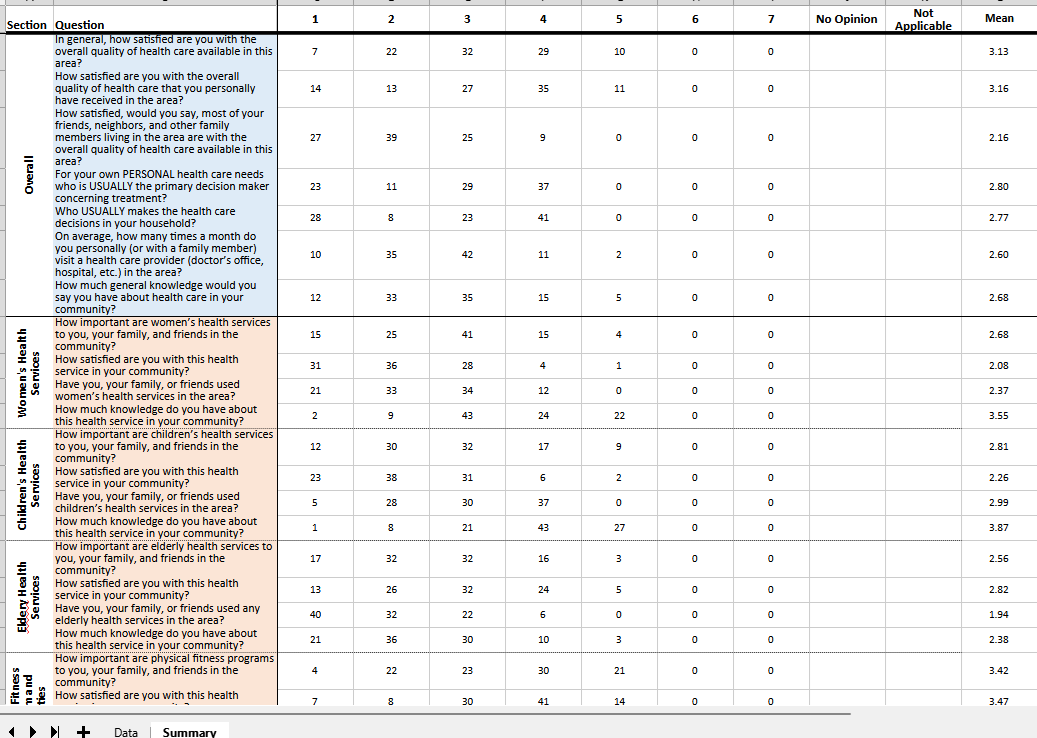
After the survey has been completed you will receive an Excel data file containing the survey data plus statistical norms for every survey item. A convenient summary sheet will be provided to quickly gauge the responses for each survey question, as well as the computed averages for important question sets.
- Data: The raw data containing the results from the survey.
- Summary: A sheet which summarizes the survey responses.
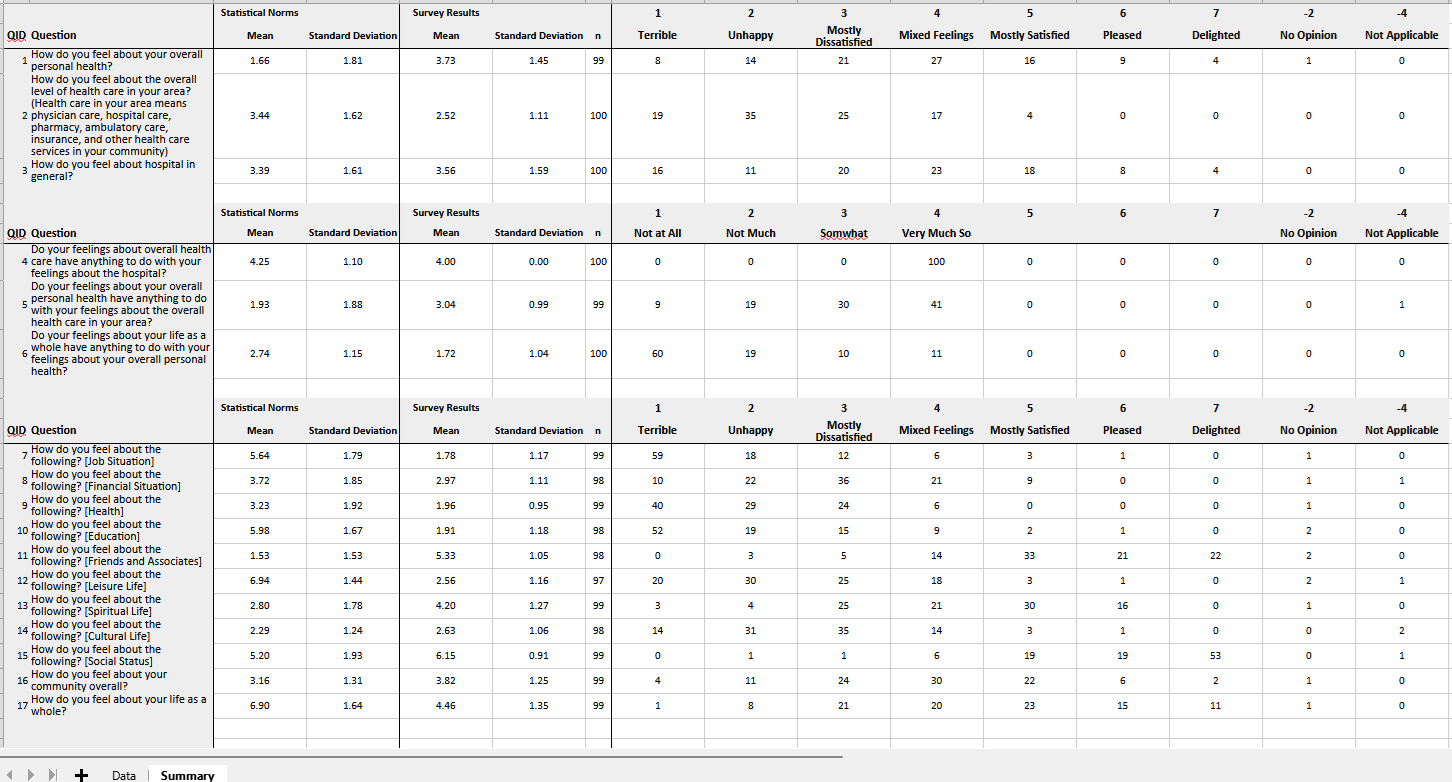
After the survey has been completed you will receive an Excel data file containing the survey data plus statistical norms for every survey item. A convenient summary sheet will be provided to quickly gauge the responses for each survey question, as well as the computed averages for important question sets.
- Data: The raw data containing the results from the survey.
- Summary: A sheet which summarizes the survey responses.
If the spreadsheet provided is insufficient for your needs, you may also want to consider asking MIQOLS to produce an official report. Official reports can provide not only an analysis and visualization (in the form of charts and graphs) for each survey item, but also further analysis with respect to specific demographics of interest.
The production of an official report varies greatly depending on the specific needs of clients. If you are interested in pursuing this option, please contact us (office@miqols.org) to discuss in detail your requirements.

The report is structured as follows:
- Cover page: A title page with applicant contact information and MIQOLS contact information
- Executive Summary: The entire content of the report is summarized here.
- Theory and Model: The theoretical model underlying the survey is described here and the theoretical constructs are clearly defined. The research supporting the model is also discussed in this section.
- Description of the Survey: This section contains a description of the constructs with corresponding survey items.
- Sampling and Data Collection: This part of the report describes the call issued to people to participate in the survey, the deadline imposed, any incentives used to encourage participation, the survey link, the number of people who actually participated in the survey, the total number of people contacted, and the response rate. The response rate is compared to past response rates.
- Survey Results: This section of the report provides descriptive statistics related to each survey item with figures (e.g., bar charts) against the norm. The norm is calculated based on the average of all past surveys that have been administered through MIQOLS.
- Discussion and Recommendations: The survey results are then summarized and interpreted in this section. As such, specific strengths and weaknesses are identified.
- References: Exact references of corresponding text citations are fleshed out in this section.
- Appendices: Extra detailed information related to any aspect of the report is placed in this section.
Example Reports
- Community-Quality-of-Life Example Report
- Consumer-Wellbeing Example Report
- Quality-of-College-Life Example Report
- Quality-of-Community-Healthcare Example Report
- Quality-of-Work-Life Example Report
Project Fee
$1000 to help set up the survey site for your data collection (guided by the validated survey measures). After the completion of data collection, we will deliver an Excel data file containing the survey data plus statistical norms for every survey item. If you would like a full report with charts and recommendations, you can contact our office to discuss in detail your requirements and the corresponding payment.
To request MIQOLS to conduct a Quality-of-Community-Healthcare SurveyHospital Wellbeing Survey, please send an e-mail message to the executive director of MIQOLS, Joe Sirgy, at office@miqols.org indicating interest. You can also contact MIQOLS by letter (address: 6020 Lyons Road, Dublin, Virginia 24084, USA) or by phone (540-674-5022; leave voicemail message). A staff member will contact you by e-mail to set up a telephone (or Skype or ZOOM) meeting. The staff member will answer whatever questions you may have and discuss the logistics of the entire project, the cost, survey specifications, time line, delivery of the survey report and other details.
The Theoretical Model Underlying the Survey
Description of the Survey
Conducting the Survey
The Survey Report
Project Fee
The Theoretical Model Underlying the Survey
The relationship between hospital satisfaction and life satisfaction is that life satisfaction is functionally related to satisfaction with all of life’s domains and subdomains. Life satisfaction is influenced by the lower levels of life concerns. This argument is supported by the Andrews and Withey (1976) model, which maintains that life satisfaction occurs at various levels of specificity. That is, life satisfaction is influenced by evaluations of individual life concerns. Thus, the greater the satisfaction with such concerns as personal health, work, family, and leisure, the greater the satisfaction with life in general.
The relation between satisfaction with hospital services and life satisfaction is a type of bottom-up spillover effect. There is an indirect relationship between hospital satisfaction and life satisfaction mediated by community health care and personal health, as shown in Figure 2 below.

References
Sirgy, M. J., Hansen, D. E., & Littlefield, J. E. (1994). Does hospital satisfaction affect life satisfaction?. Journal of Macromarketing, 14(2), 36-46.
Bibliography
Akter, S., D’Ambra, J., & Ray, P. (2010). Service quality of mHealth platforms: development and validation of a hierarchical model using PLS. Electronic Markets, 20(3), 209-227.
Akter, S., D’Ambra, J., & Ray, P. (2010). User perceived service quality of mHealth services in developing countries.
Chance, Z., & Deshpandé, R. (2009). Putting patients first: social marketing strategies for treating HIV in developing nations. Journal of Macromarketing, 29(3), 220-232.
Islam, S., Muhamad, N., & Sumardi, W. H. (2022). Customer-perceived service wellbeing in a transformative framework: Research propositions in the area of health services. International Review on Public and Nonprofit Marketing, 19(1), 219-245.
Lee, D. J., & Sirgy, M. J. (2004). Quality-of-life (QOL) marketing: Proposed antecedents and consequences. Journal of Macromarketing, 24(1), 44-58.
Rahtz, D. R., & Sirgy, M. J. (2000). Marketing of Health Care Within a Community:: A Quality-of-Life/Needs Assessment Model and Method. Journal of business research, 48(3), 165-176.
Rahtz, D. R., Sirgy, M. J., & Lee, D. J. (2004). Further validation and extension of the quality-of-life/community-healthcare model and measures. Social Indicators Research, 69(2), 167-198.
Sirgy, M. J. (1998). Materialism and quality of life. Social indicators research, 43(3), 227-260.
Sirgy, M. J. (2021). Macromarketing metrics of consumer well-being: An update. Journal of Macromarketing, 41(1), 124-131.
Sirgy, M. J., Lee, D. J., & Rahtz, D. (2007). Research on consumer well-being (CWB): Overview of the field and introduction to the special issue. Journal of Macromarketing, 27(4), 341-349.
Sirgy, M. J., Lee, D. J., Larsen, V., & Wright, N. D. (1998). Satisfaction with material possessions and general well-being: The role of materialism. Journal of consumer satisfaction, dissatisfaction and complaining behavior, 11, 103-118.
Woo, E. (2013). The impacts of tourism development on stakeholders’ quality of life (QOL): A comparison between community residents and employed residents in the hospitality and tourism industry.
Description of the Survey
|
|
I. SATISFACTION MEASURES | II. LIFE DOMAIN SATISFACTION |
| III. OVERALL LIFE SATISFACTION | IV. DEMOGRAPHICS |
Targets of the survey are introduced to the survey questionnaire via a cover letter from the client describing the objectives of the survey. Participants are assured that their responses would remain confidential and anonymous.
The questionnaire consists of three major sections. The first section involves the satisfaction measures for healthcare and hospitals.
The second section focuses on measures of satisfaction with various life domains, including the work domain, and life overall.
The last (third) section of the questionnaire contains demographic questions related to gender, age, educational level, years of service in current type of work, and years of service.
Conducting the Survey
The Management Institute for Quality-of-Life Studies (MIQOLS) provides assistance in conducting the survey (online). The survey is first adapted to the exact specification of the organization in question. The adapted version of the survey is then posted on MIQOLS website for data collection. The staff at the client publicizes a call to the participants to complete the online survey anonymously and confidentially. A link is provided with the call to complete the survey with a specific deadline.
After the deadline, the survey site is closed, data analyzed, and a report is issued to the client organization. To see an example of a typical report, see the Survey Report section below.
The Survey Report
After the survey has been completed you will receive an Excel data file containing the survey data plus statistical norms for every survey item. A convenient summary sheet will be provided to quickly gauge the responses for each survey question, as well as the computed averages for important question sets.
- Data: The raw data containing the results from the survey.
- Summary: A sheet which summarizes the survey responses.
After the survey has been completed you will receive an Excel data file containing the survey data plus statistical norms for every survey item. A convenient summary sheet will be provided to quickly gauge the responses for each survey question, as well as the computed averages for important question sets.
- Data: The raw data containing the results from the survey.
- Summary: A sheet which summarizes the survey responses.
If the spreadsheet provided is insufficient for your needs, you may also want to consider asking MIQOLS to produce an official report. Official reports can provide not only an analysis and visualization (in the form of charts and graphs) for each survey item, but also further analysis with respect to specific demographics of interest.
The production of an official report varies greatly depending on the specific needs of clients. If you are interested in pursuing this option, please contact us (office@miqols.org) to discuss in detail your requirements.
The report is structured as follows:
- Cover page: A title page with applicant contact information and MIQOLS contact information
- Executive Summary: The entire content of the report is summarized here.
- Theory and Model: The theoretical model underlying the survey is described here and the theoretical constructs are clearly defined. The research supporting the model is also discussed in this section.
- Description of the Survey: This section contains a description of the constructs with corresponding survey items.
- Sampling and Data Collection: This part of the report describes the call issued to people to participate in the survey, the deadline imposed, any incentives used to encourage participation, the survey link, the number of people who actually participated in the survey, the total number of people contacted, and the response rate. The response rate is compared to past response rates.
- Survey Results: This section of the report provides descriptive statistics related to each survey item with figures (e.g., bar charts) against the norm. The norm is calculated based on the average of all past surveys that have been administered through MIQOLS.
- Discussion and Recommendations: The survey results are then summarized and interpreted in this section. As such, specific strengths and weaknesses are identified.
- References: Exact references of corresponding text citations are fleshed out in this section.
- Appendices: Extra detailed information related to any aspect of the report is placed in this section.
Example Reports
- Community-Quality-of-Life Example Report
- Consumer-Wellbeing Example Report
- Quality-of-College-Life Example Report
- Quality-of-Community-Healthcare Example Report
- Quality-of-Work-Life Example Report
Project Fee
$1000 to help set up the survey site for your data collection (guided by the validated survey measures). After the completion of data collection, we will deliver an Excel data file containing the survey data plus statistical norms for every survey item. If you would like a full report with charts and recommendations, you can contact our office to discuss in detail your requirements and the corresponding payment.
To request MIQOLS to conduct a Quality-of-Community-Healthcare SurveyHospital Wellbeing Survey, please send an e-mail message to the executive director of MIQOLS, Joe Sirgy, at office@miqols.org indicating interest. You can also contact MIQOLS by letter (address: 6020 Lyons Road, Dublin, Virginia 24084, USA) or by phone (540-674-5022; leave voicemail message). A staff member will contact you by e-mail to set up a telephone (or Skype or ZOOM) meeting. The staff member will answer whatever questions you may have and discuss the logistics of the entire project, the cost, survey specifications, time line, delivery of the survey report and other details.
 miqols.org